





When Does a Tooth Need an Implant Instead of Another Crown?
When a tooth is damaged, the next step is to determine how it should be treated. In many cases, a crown can restore and protect the tooth. But when a tooth has already been repeatedly treated with crowns or root canal treatment, fractured below the gum line, or weakened by extensive decay, a crown may not be the best option.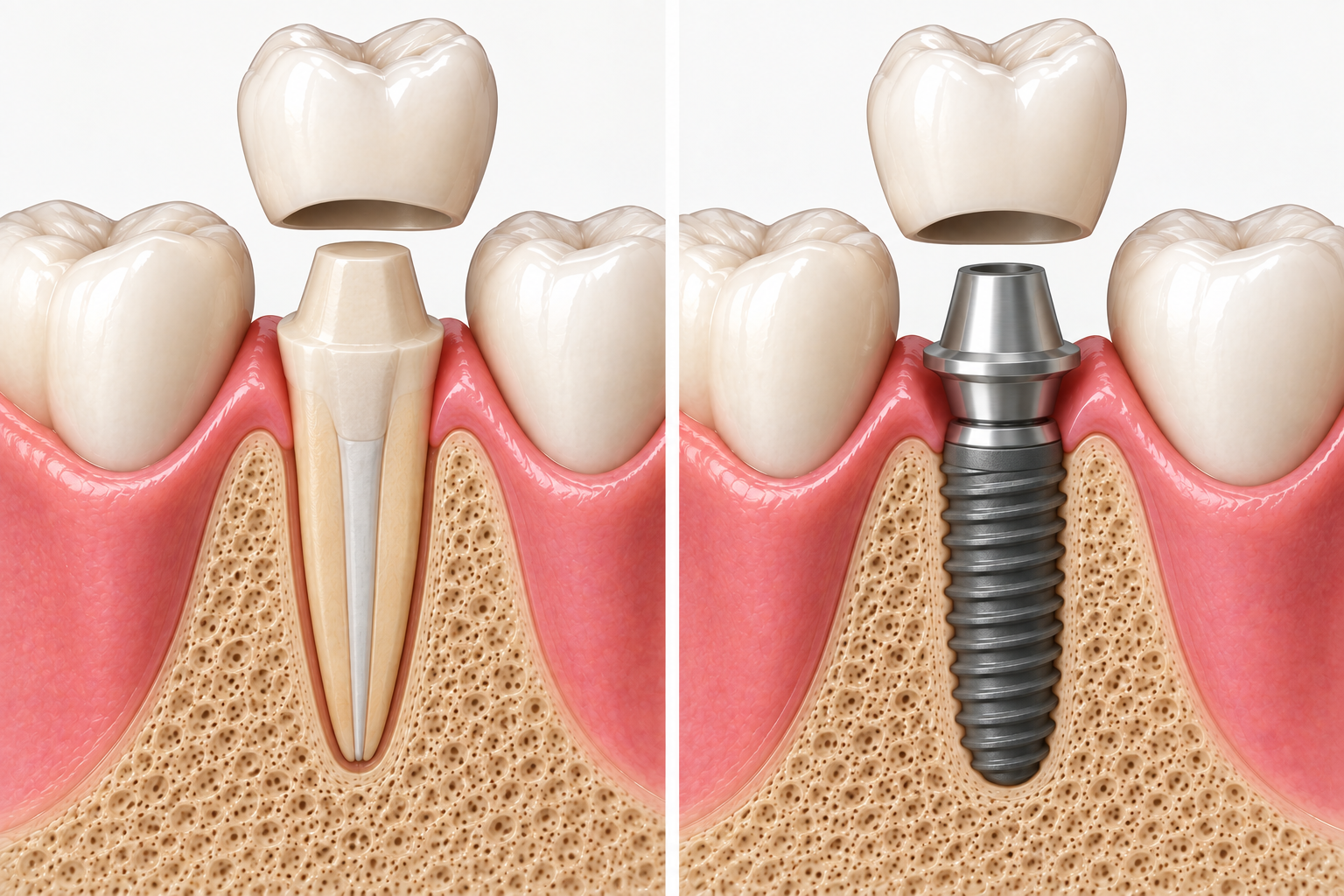 A careful decision needs to be made about whether the tooth can be restored predictably and with a reasonable prognosis for longevity. That decision requires more than looking at a single X-ray. We evaluate the amount of healthy tooth structure, the location and extent of any fracture or decay, the condition of the surrounding teeth, gums, and bone, and the forces the tooth will need to withstand.
When a tooth cannot be predictably restored, an implant may offer a more reliable way to replace it. An implant functions as an artificial tooth root and is fitted with a custom crown on top. In some situations, this can actually be a conservative option because it replaces the missing tooth without requiring the preparation of neighboring healthy teeth, as would be necessary for a traditional bridge. At Prosthodontic Associates, we approach these decisions by understanding the condition of the tooth, the reasons previous treatment may have failed, the forces placed on that tooth, the overall bite, and the needs of the entire mouth. Sometimes the most conservative choice is to restore the natural tooth. In other situations, removing a compromised tooth and replacing it with an implant may protect the surrounding teeth and provide a more predictable long-term result. We look beyond the single tooth to determine which treatment offers the best balance of preservation, predictability, longevity, and function.
Comments are closed.